


Reading time: 10 minutes | Audience: Consumer analysts applying behavioural science through AI
Summary
Claude Opus contains 130+ behavioural science frameworks applicable to consumer decision-making. Applied without segment data, the theory remains generic. The geoTribes Intelligence MCP provides localisation – grounding behavioural theory in empirical data for 15 defined Australian consumer segments. Quick Append extends the integration by appending segment codes to surveys and customer databases. Three activation pathways – Living Insights, DMP platforms, and Explorer – connect insight to execution using the same segment definitions.
Consumer analysts working with customer data increasingly recognise the opportunity that behavioural science offers. Frameworks like prospect theory, mimetic desire, mental accounting and social proof provide explanatory depth that descriptive analytics alone cannot deliver. They explain why customers behave as they do – not just what they do.
Claude Opus contains working knowledge of 130+ behavioural science frameworks applicable to consumer decision-making. Ask about loss aversion for a purchase decision and you receive an explanation of how reference points shape evaluation, how probability weighting distorts risk assessment and how framing effects influence choice.
The limitation becomes apparent in application. Behavioural science frameworks describe mechanisms that operate across populations – but they do not specify how those mechanisms manifest for particular customer segments. Loss aversion exists; but does it operate the same way for high-income risk-tolerant households as for financially anxious families? How does probability weighting differ between segments with capacity to absorb shocks versus those without?
Without grounding in segment-level data, behavioural science applied through AI remains generic while customer analytics requires specificity.
geoTribes Intelligence provides that grounding. The integration delivers three connected capabilities: localisation of behavioural theory to Australian consumer segments; context integration through segment appending to surveys and customer databases and an activation path through the geoTribes ecosystem.
1. Localisation: grounding theory in segment data
geoTribes Intelligence contains psychographic, behavioural, and economic indicators across 20+ category banks for 15 defined Australian consumer segments – from Affluentials and Achievers to Battlers and Elders. When Claude Opus queries this data, the retrieval operates through semantic similarity matching: the query is embedded as a vector and matched against the database to return relevant segment indicators.
The returned data – segment names, category values, indices – enters Claude Opus’s context window. During response generation, attention weights are computed dynamically, creating relevance structures between the behavioural science concepts encoded in Claude Opus’s parameters and the empirical geoTribes data. The output connects theoretical frameworks to specific segment indicators.
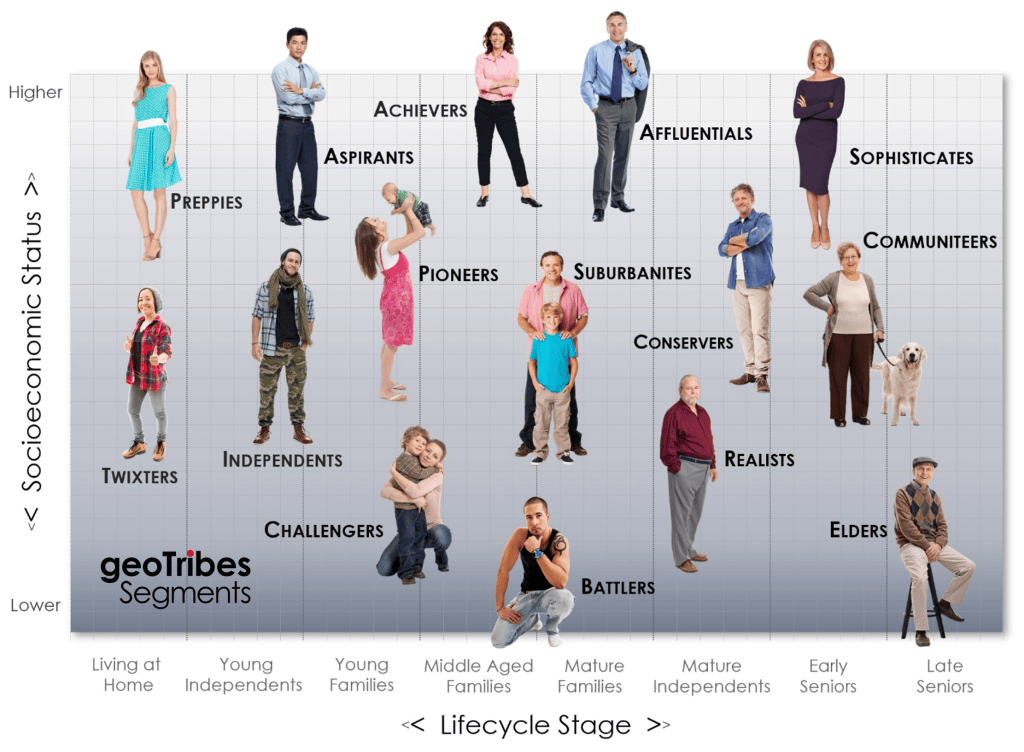
Consider loss aversion for international travel purchase decisions. With geoTribes data in context:
| Segment | Financial Anxiety | Risk Appetite | Income Index | Mechanism Profile |
|---|---|---|---|---|
| Aspirants | 25.6% (Index 116) | 45.8% (Index 140) | 115 | Experiential loss aversion; FOMO dominant; financial risk tolerance |
| Independents | 30.2% (Index 137) | 47.4% (Index 145) | 84 | Financial loss aversion despite high risk appetite; domain conflict |
| Conservers | 19.5% (Index 89) | 24.9% (Index 76) | 95 | Status quo preservation; uniform loss aversion; risk adverse decision making |
| Twixters | 29.8% (Index 135) | 53.7% (Index 165) | 111 (household) | Intention-behaviour gap; high desire, constrained capacity |
The Independents pattern illustrates what localisation produces: high experiential risk tolerance (Index 145) combined with financial anxiety (Index 137) and constrained income (Index 84). Claude Opus interprets this as domain conflict – willingness to take experiential risks but sensitivity to financial exposure. The strategic implication follows: Independents respond to price certainty and financial protection messaging rather than experiential reassurance.
This is localised behavioural science – theory calibrated to specific Australian segment indicators.
2. Context integration: appending segments to your data
geoTribes Intelligence provides baseline psychographic profiles. Most research projects also require category-specific context: How does this segment respond to your brand? What are their stated preferences in this category? How do they actually behave in your customer database?
Quick Append (quickappend.geotribes.com) appends geoTribes segment codes to surveys and customer databases. This enables Claude Opus to work across three converging data streams: the psychographic profile from geoTribes Intelligence (who the segment is – values, anxieties, motivations, capacity); stated preferences from appended survey data (what the segment says – attitudes, intentions, claimed drivers) and revealed preferences from appended customer data (what the segment does – actual purchase, frequency, value, response).
| Data Stream | Source | What It Reveals |
|---|---|---|
| Psychographic Profile | geoTribes Intelligence | WHO the segment is: values, anxieties, motivations, lifestyles, capacity |
| Stated Preferences | Appended survey data | WHAT the segment says: attitudes, intentions, claimed drivers |
| Revealed Preferences | Appended customer data | WHAT the segment does: actual purchase, frequency, value, response |
The integration across data sources uses geoTribes segments as the unifying key. This enables validation of psychographic predictions against actual behaviour, identification of intention-behaviour gaps, and measurement of campaign response by segment. The analyst prompts with a question; Claude Opus reconciles psychographic profiles with survey responses and transaction data; the analyst receives an integrated interpretation.
3. Activation: connecting insight to execution
When Claude Opus analysis identifies segment-specific strategies, the operational questions follow: How does the media team reach them? Which customers in the CRM match? Which stores over-index? The geoTribes ecosystem provides three activation pathways that use the same segment definitions as the analysis.
Living Insights (geotribes.com/living-insights) appends geoTribes segments to customer and audience databases. When analysis identifies that Aspirants should receive experiential messaging while Twixters need financial reassurance, Living Insights enables those segments to be identified within the CRM or data warehouse. Available via Web interface, SFTP batch processing, or real-time API.
geoTribes and geoSmart segments are available as addressable digital audiences in major DMP platforms including Google and The Trade Desk. Segment-specific messaging strategies can be targeted directly in programmatic, social and mobile campaigns.
geoTribes Explorer (geotribes.com/explorer) maps segments to physical locations – postcodes, SA1s, store catchments and outdoor media assets. This supports OOH campaign planning by segment concentration, store ranging aligned to catchment profiles and site selection based on target segment density.
| Activation Pathway | Platform | Use Cases |
|---|---|---|
| Customer Database | Living Insights | CRM segmentation by geoTribes; segment-level LTV; Claude Opus strategies activated in customer communications |
| Digital Media | DMP Platforms | Programmatic, social, mobile targeting of geoTribes segments; analysis-to-activation continuity |
| Geographic | Explorer | OOH planning, store ranging, field territories, direct mail, site selection |
The same geoTribes segments used in Claude Opus analysis are the segments activated across these platforms. Insight connects to execution through a common segmentation framework.
4. The analytical ecosystem
The integration connects Claude Opus’s behavioural science capability to geoTribes data and activation infrastructure. The analyst’s role remains central: framing the problem, prompting the analysis, evaluating the interpretation and owning the recommendation.
| Component | Function |
|---|---|
| Claude Opus | Behavioural science depth (130+ frameworks); synthesis with segment data; interpretation generation |
| geoTribes Intelligence | Localisation – psychographic, behavioural, economic indicators for 15 Australian segments across 20+ category banks |
| Quick Append | Context integration – appends segment codes to surveys and customer databases |
| Living Insights | Database activation – segments available in CRM, data warehouse, Marketing Cloud |
| DMP Platforms | Paid media activation – segments addressable in Google, The Trade Desk, programmatic campaigns |
| Explorer | Geographic activation – segments mapped to postcodes, SA1s, catchments, outdoor media assets |
| Consumer Analyst | Problem framing, prompting, evaluation, recommendation ownership |
Each project using geoTribes segments builds on the last. The stable segmentation framework means insights accumulate over time rather than starting fresh with each study. Campaign responses measured by segment inform subsequent analysis; behavioural predictions validated against actual outcomes refine future recommendations.
A Powerful New Capability for Consumer Analysts
Applying behavioural science with confidence has often meant qualitative research, academic consultation, or trial-and-error interpretation of frameworks that were developed in laboratory settings and may or may not translate to specific market segments.
The integration of geoTribes Intelligence with Claude Opus offers a more accessible path. The behavioural science depth is available through Claude Opus. The localisation to Australian consumer segments is available through geoTribes Intelligence. The context integration is available through Quick Append. The activation pathways are available through Living Insights, DMP platforms and Explorer.
Applications include informing messaging strategy with segment-level behavioural profiles, analysing path to purchase for target segments and simulating consumer behaviour in competitive scenarios.
The integration of Claude Opus and geoTribes Intelligence offers consumer analysts a powerful, practical and readily implemented capability for applying behavioural science at the segment level.
Resources
- geoTribes Intelligence: Psychographic segment database (MCP-connected)
- Quick Append: quickappend.geotribes.com
- Living Insights: geotribes.com/living-insights
- Explorer: geotribes.com/explorer
- Digital Media: geoTribes segments available in major DMP platforms