


Summary
RDA, the company behind the geoTribes Platform, has been supplying custom corporate segmentation schemes for more than fifteen years. Its work spans the standard 15-level geoTribes segmentation, customised architectures that are purpose-built to the individual needs of particular corporate clients and a projection framework that allows segmentations built by in-house teams, research agencies and other partners to be loaded into the same activation infrastructure.
This article examines how AI is changing the value of strategic customer segmentation, based on emergent developments across the field.
What is a Strategic Customer Segmentation?
Purpose-built strategic customer segmentations provide a single shared language for discussing customers, applied consistently across proposition development, marketing, sales, service and growth planning. It identifies distinctive customer groups on strategically important dimensions like needs, values, behaviours, attitudes and commercial potential.
Segmentations become more valuable as enterprise adoption broadens, with widely adopted segmentations being embedded in planning, appended to operational systems and increasingly consulted by AI agents. The segment profiles can create a common language for both management and AI agents.
These strategic segmentations generally have a small set of segments, supported by artefacts like pen portraits and persona documents, slide decks, internal database tags, training programmes and role-playing workshops.
How Strategic Customer Segmentations are Built
Clustering analysis is the standard method for segment identification. It groups customers whose patterns across the chosen clustering dimensions are similar enough to be treated as a single segment while remaining distinct from other groups. The most significant difference is the input data, where two data foundations are typical, often used in combination:
- A dedicated Segmentation Survey. A bespoke study sized for statistical robustness across the dimensions enterprises want to use to discriminate between segments, typically needs, values, behaviours, attitudes, commercial potential and feature responsiveness.
- First-party transaction data. Where enterprises hold their own transactional records (purchases, channel use, product mix, frequency, value, interaction patterns), those records inform the cluster solution and validate segment differentiation against actual commercial behaviour.
Because the resulting segmentation is fundamentally grounded in enterprise-specific data from one or both of these sources, it offers distinct benefits over generic alternatives.
What are the Benefits Over Generic Segmentations?
Off-the-shelf segmentation products (like Mosaic and Helix) are built to the generic characteristics of the population rather than the strategic priorities of enterprises. A purpose-built strategic customer segmentation offers four distinct benefits:
- Strategic alignment. Built around the commercial questions the organisation faces (category penetration, brand portfolio fit, lifetime value, churn risk, propensity to switch) rather than a vendor’s general-purpose framing.
- Cultural and linguistic fit. Segment names and supporting narrative use the vocabulary already in use internally. The segmentation becomes the vehicle for their incorporation into planning documents and processes.
- Proprietary knowledge. Qualitative material, customer interviews, sales force observations and churn analyses that exist only within enterprises can be incorporated directly into segment descriptions.
- Institutional authority. Once adopted, the segments become the language of strategic debate and decision-making, across enterprises.
Limiting Factors
Two factors can limit the value that enterprises get from their strategic customer segmentation.
The first is the cognitive barrier, created by users needing to have a detailed understanding of the segmentation to put it to effective use. This means knowing who each segment represents, what motivates them, how they respond, how they differ. That understanding has to be built and carried by individual users, so the depth of use has tended to be limited by managers’ capacity and willingness to build the requisite depth of segment knowledge and by the impact of staff turnover.
The second is technical distribution constraints that limit the availability of the segmentation at all relevant touchpoints. A segmentation built on a specific data source (a Segmentation Survey, a first-party customer file) is bounded by that source, so reaching CRM, media activation, geospatial planning and follow-up research requires data linkage that can be difficult to achieve comprehensively. The problem is most acute for segmentations built on customer data, which are difficult to activate in other channels.
How AI is Expanding the Role and Value of Strategic Customer Segmentation
AI is creating a dynamic that makes enterprise-wide access to deep customer knowledge, delivered through a strategic customer segmentation, even more compelling. It is working in two directions, from consumers’ perspective outside enterprises and from the managerial perspective within them.
Impact on customer relationships
AI is inserting itself between customers and the enterprises that serve them. Search engines produce AI summaries of products and recommend choices before consumers reach the brand. Buying agents are beginning to browse, evaluate and transact on customers’ behalf. Advertising optimisers (Google PMax, Meta Advantage+, Amazon Ad Relevance) decide which message reaches which customer, when and at what bid.

Each system depends on the customer knowledge available to it. The advertising platforms make this dependency most immediate. Where targeting teams once applied judgement, optimisation engines now make those decisions inside the platform, drawing on the messaging, propositions and briefing materials they ingest. Deep customer knowledge has to be reflected in these inputs if AI is to optimise toward enterprises’ view of their customers. A strategic segmentation provides that knowledge in a structured, consistent form.
Impact on enterprises
Inside enterprises, AI is expanding how segmentation schemes can be accessed and used in three ways, from simpler to more sophisticated.
- Natural-language access: from segment detail to strategic dialogue
Natural-language AI helps to overcome the cognitive barrier. A user can ask the strategic question they have, in their own words, such as whether a proposition will resonate with younger renters in inner suburbs, whether price elasticity will differ for premium segments in a downturn, which segments are most receptive to a sustainability message. MCP (Model Context Protocol) servers expose the segmentation to enterprises’ LLMs and copilots and the AI handles the segment-level reasoning. The segmentation reaches more decisions because more decision-makers can use it without first becoming segment specialists. - Persona-led ideation: from data to dialogue
With the cognitive barrier reduced, users can ideate, brainstorm and run what-if explorations before they have a fully formed strategic question. The segmentation functions as a ready-made research environment, on demand.
AI personas give first-party data a human face. Behavioural records describe what customers do; personas built from those records speak in their voice, articulating motivations, constraints and trade-offs. A segment that was once a row of statistics or a narrative persona statement becomes a “living” character to interact with. - Synthetic personas: from ideation to simulation
Synthetic personas extend persona-led ideation into structured simulation. Each segment generates one persona that responds to propositions, prices and creative variants on behalf of customers in its segment. The same persona can also be used to model buying processes, evaluate the path to purchase and assess competitive positioning from the segment’s perspective. These simulations are typically run through agentic AI environments like Claude Cowork or ChatGPT agent, allowing scenarios to be tested before any research reaches the field. A new layer of research is emerging around synthetic personas, complementing traditional approaches.
Real-world Enablement for Strategic Customer Segmentation
The benefits of strategic customer segmentation are real and of increasing importance but historically constrained by cognitive complexity and distribution gaps. geoTribes provides a two-component enablement solution based on the geoTribes Framework Segment Encoding and Matchkey system for segment building and the geoTribes Platform for multi-touchpoint activation that overcomes these and provides effective real-world strategic customer segmentations.
The geoTribes Framework: Building the Segmentation
The geoTribes Framework is the technical foundation developed by RDA for building strategic customer segmentations and linking them to customer data, survey records and information sources (population estimates, geospatial areas, bank transaction data). Strategic customer segmentation schemes built on this foundation inherit its established encoding and linkage capabilities, based on two distinct mechanisms.
The Segment Encoding maps the segmentation onto the geoTribes synthetic population, a statistical model of Australian households and people, based on anonymised sources. Each unit in the population carries its segment code once encoded. The encoding logic varies from simple mappings to more sophisticated assignment methods for segmentations that incorporate additional measures.
The Matchkey is the composite lookup key at which segment codes, profiling values and Human Insights variables are appended to customer records and survey responses. For databases, it combines SA1 (fine-grained geographic indicator), address type, age band and gender code; for surveys, suburb and postcode replace SA1. The Matchkey summarises the encoded synthetic population at this granularity, enabling these values to be looked up from a customer’s Matchkey components with minimal PII being required to leave the client environment.
Three analytical options are available for segment construction within the geoTribes Framework, ordered by build effort:
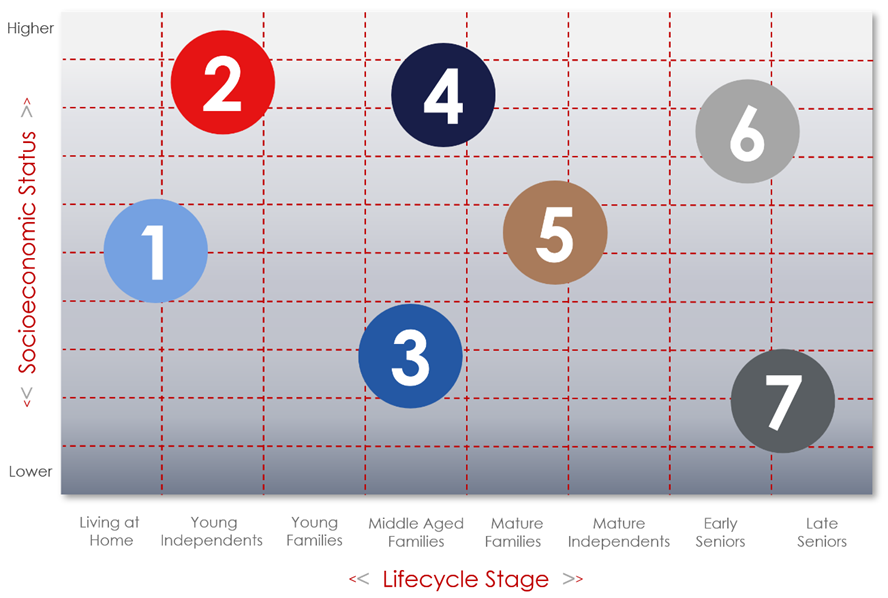
- Grouping the 15 geoTribes segments. The simplest option. The 15 standard geoTribes segments are combined based on similarity in response profiles on the dimensions relevant to the strategic concerns of enterprises. This can be done by clustering on the segments themselves or by judgement-based mapping. The Segment Encoding is straightforward. Segments map to aggregations of the 80 LCS × SES cells. The result is a custom scheme that works on databases, in surveys and geospatially, with full population coverage.
- Custom clustering on the 80 Lifecycle Stage (8) × Socioeconomic Status cells (10). The analyst aggregates the foundation data (Segmentation Survey, first-party transaction data) to the 80 cells, then applies cluster analysis to identify groups of cells with similar characteristics and response patterns. The Segment Encoding follows directly. Each of the 80 cells is assigned to one of the resulting clusters. The result is a custom segmentation suited to strategic questions well served by lifecycle and socioeconomic discrimination
- Additional measures in the cluster build. Where strategic questions need more dimensionality than LCS and SES, the Segment Encoding becomes more sophisticated, incorporating additional measures at two levels. The analysis can be extended with geographic grouping factors like regionality (ARIA) or concentrations of particular cultural groups. Beyond this, the Human Insights library allows variables across motivations, attitudes, lifestyles, sustainability behaviours and demographics to be incorporated directly in segment construction.
It is also possible to add a microcluster layer beneath the segments to explore relationships between measures within a segment, such as how cultural background interacts with sustainability among demographically similar customers. This can support more specific synthetic personas.
The geoTribes Human Insights library: 700+ variables already done
All three options can draw on the geoTribes Human Insights library for in-depth profiling by “whole of life measures”. The library contains more than 700 profiling variables covering motivations and values, media consumption, attitudes, lifestyles, household and person economics, sustainability behaviours and detailed demographics. It’s built from anonymised market research surveys and government microdata, combined with the synthetic population, in a fully parametric process that uses no PII.
The library provides a “whole of life” perspective that is complementary to the client-specific data from a dedicated Segmentation Survey or customer transaction data, meaning that this data doesn’t need to be collected on a project-by-project basis to create rounded segment and microcluster personas. Project-specific work is then only needed for questions unique to the brand or category.
The geoTribes Platform: Activating and Distributing the Segmentation to Enterprise Touchpoints
With the client’s strategic customer segmentation grounded in the geoTribes Framework, the geoTribes Platform helps deliver it into enterprise environments. Every tool in the Platform is purpose-built around the Framework, using the synthetic population and Matchkey to convey the segmentation into specific channels, systems or workflows:
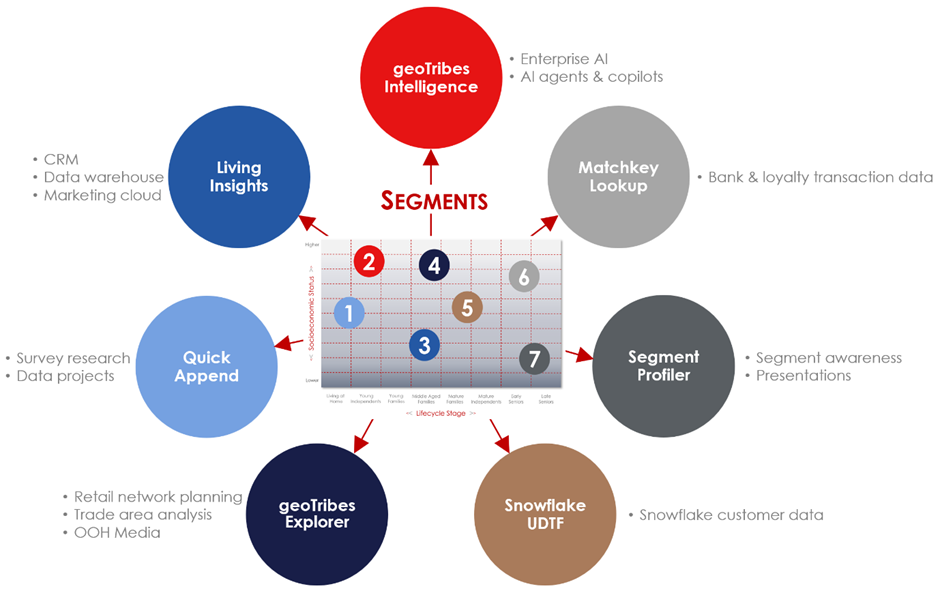
- geoTribes Intelligence: delivers the segmentation into enterprises’ AI environments via the Model Context Protocol, where AI agents and copilots consult it in the tools already in use.
- Living Insights: appends the segmentation onto customer records at enterprise scale, delivered via secure web or SFTP into CRM, data warehouse and marketing cloud environments.
- Quick Append: brings the segmentation into research workflows by appending it to survey and project records and produces database profiling reports formatted as LLM prompts.
- geoTribes Explorer: projects the segmentation into geospatial planning workflows at national, state, postcode and suburb level. Used for network planning, trade area analysis and out-of-home media.
- Snowflake UDTF: delivers the segmentation natively inside enterprises’ Snowflake environments, with no PII or client data exposure.
- Segment Profiler: makes the segment profiles available on demand, overall and by gender, for use in analysis and presentations.
- Matchkey Lookup Table: extends the segmentation into datasets that cannot be released for appending, most commonly bank or loyalty transaction data. RDA produces a portable lookup table; the custodian applies it on their side; segmented summaries flow back.
Every tool uses the same definitions, creating a common language across all users in enterprises, both management and AI agents, regardless of their access channel or customer touchpoint.
Privacy-preserving Integration
Enterprise customer and transaction data are processed in a four-stage sequence with minimal exposure to RDA:
- A minimal subset of data on the client’s customer records passes through Living Insights to have the segment codes, profiling values and Human Insights variables, appended. Only address, age band and gender code are sent. No names, contact details or other identifying information leave the client environment.
- The enriched file returns to the client environment under full client control.
- The client merges its behavioural measures (transactions, channel use, purchases) on its own premises. Transaction data never leaves the client environment.
- The enriched-and-behavioural file is aggregated to the appropriate level and from that point on, all analytical work is based on aggregate data.
Only minimal PII is exposed to RDA and only for the duration of the appending process. Transaction data is never exposed to RDA at all.
Enterprise Readiness
The geoTribes Platform is hosted on AWS in line with the Well-Architected Framework, AWS’s standard for security, reliability and operational excellence. It has recently completed independent penetration testing by a CREST-certified Australian firm against NIST standards. The Platform is currently in the observation window for SOC 2 Type 2 accreditation, the international standard for service organisations handling customer data.
Combined with the privacy-preserving design (minimal PII passing through appending, no transaction data ever exposed to RDA), these measures support adoption by procurement and information security functions.
The Compounding Asset
A strategic customer segmentation is most valuable when it functions as the organisation’s structured customer knowledge, adopted as the language of strategy, embedded in operational systems and increasingly consulted by AI agents.
The benefits compound. Each piece of research tagged with the segments adds to the institutional record of who the customers are, what they value and how they are likely to behave.
A segmentation built on the foundation of the geoTribes Framework and loaded into the Platform can also evolve. It can be re-shaped as enterprises’ needs and perspectives change, with the new version re-deployed across the same channels and systems.
For existing segmentations that have been grounded in the geoTribes Framework, the path to AI integration is already in place. New segmentations can be built with the Framework grounding them from the start, opening the same capability. In both cases, the potential of strategic customer segmentation is fully realised, embedded in decisions, channels, AI systems and a form of language enterprises and their agents can readily share.