


Reading time: 15-18 minutes | Audience: Political and corporate strategists, market researchers, consumer insight analysts, campaign planners
Summary
One Nation’s primary vote has surged to 25-27% (January-February 2026). One Nation campaigns explicitly on reducing immigration, so its rise correlates directly with increasing anti-immigrant sentiment. The question this analysis addresses is not why One Nation benefits from that sentiment, but why economic frustration converts into accusation directed at immigrant populations in the first place. René Girard’s mimetic theory, in which social frustration is converted into directed accusation against culturally visible sub-populations, provides a plausible theoretical basis to help explain this conversion.
This analysis applies geoTribes psychographic segmentation data and Claude Opus to locate the four structural roles in Girard’s mimetic theory within the contemporary Australian population:
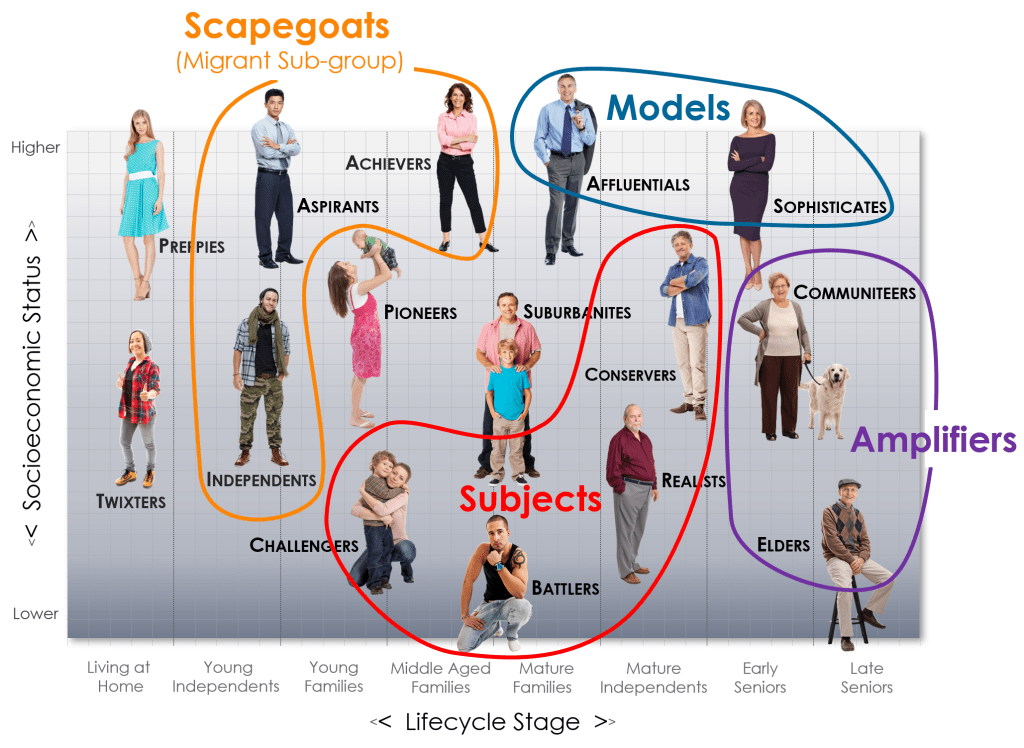
- Models — Affluentials and Sophisticates (household income 1.09–1.63× national, low anxiety, low cynicism)
- Subjects — Anglo-Australian sub-populations within Battlers, Challengers and Realists (adjusted cynicism 31.9–40.5%, nativism 25.9–38.5%, financial anxiety 37.0–42.8%)
- Amplifiers — Elders and Communiteers (nativism 1.44–1.59×, disenchantment 0.48–0.52×), with Conservers occupying a hybrid position between Subject and Amplifier (nativism 41.6%, cynicism 30.1%)
- Scapegoats — Migrant sub-populations within Aspirants, Achievers and Independents (Chinese ancestry 1.44–2.52×, Indian ancestry 1.92–2.49×, achievement multiplier 1.25–1.50)
Separate cultural analyses distinguish Anglo-Australian from East Asian and South Asian sub-populations within the same segment, revealing that the mechanism operates on visibility and cultural markers rather than economic data. geoTribes data provides the localisation that makes the analysis operational: it identifies which populations are structurally receptive to which narratives, which sub-populations are most exposed to scapegoat selection and where the political energy generated by the mechanism is concentrated.
The Context
In January 2026, One Nation recorded a primary vote of 27% in Newspoll and 25% in Roy Morgan, historic highs that placed it ahead of the Liberal Party for the first time. An anti-immigration party that operated as a minor party for three decades now commands roughly one quarter of the electorate.
Standard explanations (cost-of-living pressure, housing affordability, wage stagnation, security anxiety) describe the conditions but leave the mechanism unidentified. Economic frustration converts into anti-immigrant sentiment rather than anti-corporate sentiment. The targets are typically recent, culturally visible migrants who become scapegoated. The question is: what structural process drives this conversion?
René Girard, a French literary critic and anthropologist who spent most of his career at Stanford, proposed that the scapegoat mechanism is not a modern pathology but an archetypal process present in human societies since their origins, visible in ancient myth, biblical narrative and the foundational rituals of pre-modern cultures. His work has gained renewed contemporary influence through Peter Thiel, Girard’s most prominent student at Stanford, who credits mimetic theory with shaping his investment career (including his early backing of Facebook) and his political ideology. Thiel spoke at the 2016 Republican National Convention and funded the Trump campaign; US Vice President JD Vance has cited Girard, via Thiel, as an influence on his conversion to Catholicism. The theory now circulates actively in Silicon Valley, in American conservative political strategy and in academic circles studying populism.
This analysis applies mimetic theory not as political program but as diagnostic framework. geoTribes psychographic segmentation data, covering motivational mindsets, ancestry, income, anxiety profiles and cultural multipliers across 15 segments of the Australian population, is used to locate where in contemporary Australian society the different roles in Girard’s mimetic cycle sit.
1. The Theory in Brief
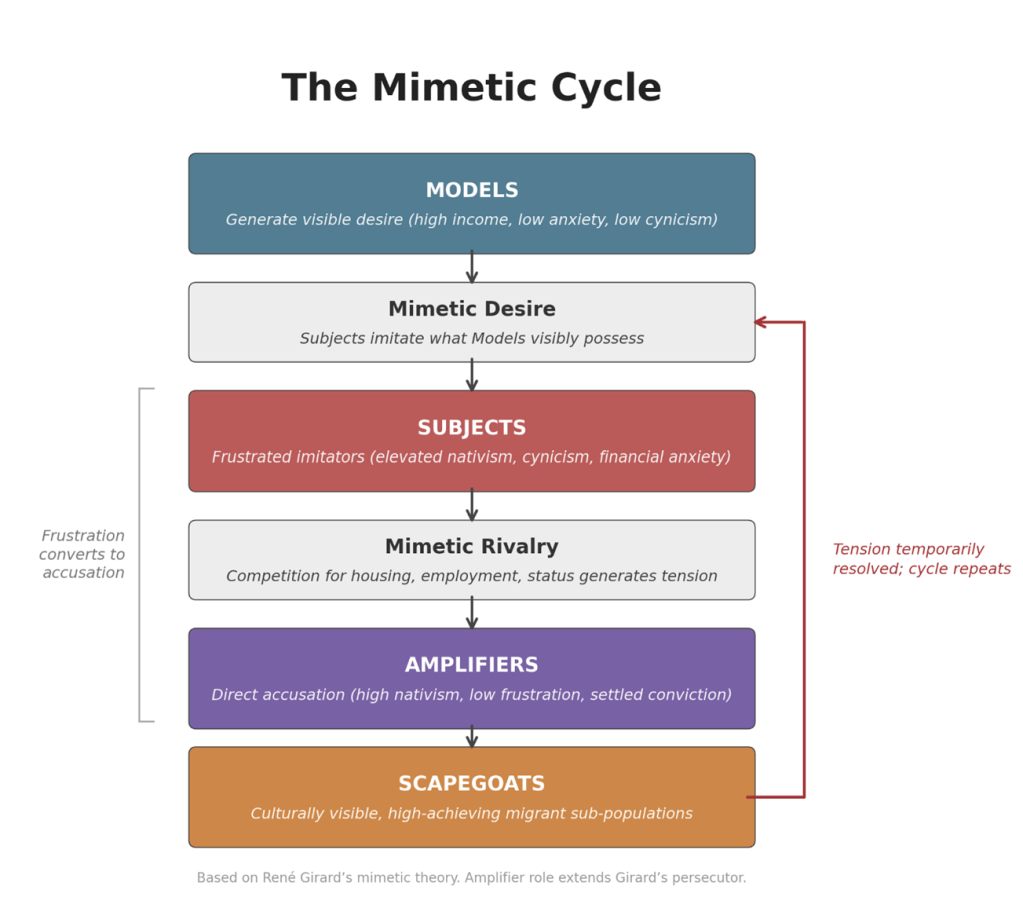
Girard identifies three stages in the generation of scapegoating.
- Mimetic desire: people desire imitatively, wanting what they observe others wanting.
- Mimetic rivalry: when many people imitate the same desire for the same objects (housing, employment, status), the resulting competition generates escalating tension.
- The scapegoat mechanism: the community converges on a single target, typically someone visible enough to be seen as a rival but positioned as enough of an outsider to be unable to counter the accusation effectively. The act of collective accusation redirects the tension onto a designated target.
In Girard’s account of pre-modern societies, this produced temporary social cohesion through ritual sacrifice or expulsion. In contemporary democracies, the target population remains present and the mechanism generates a self-reinforcing cycle rather than resolution.
Three criteria determine who gets targeted:
- The group must be visibly pursuing the same objects of desire (otherwise they cannot be experienced as a rival)
- They must be marked by cultural difference (otherwise they cannot be distinguished from the community)
- They must lack the structural capacity to counter the accusation (otherwise the mechanism fails). Immigrant groups in Australia satisfy all three.
2. Four Mimetic Roles in the geoTribes Data
The geoTribes segmentation system classifies the Australian population into 15 psychographic segments. Each carries measured scores for motivational mindsets (achievement, nativism, cynicism, disenchantment, social tolerance, entitlement), sources of anxiety (housing, employment, discrimination, financial uncertainty), personal demographics (ancestry, country of birth, language, year of arrival) and household economics (income, disposable income, wages). The system also applies cultural multipliers: scaling factors that adjust segment-level scores based on cultural background. An achievement score of 40% at the segment level produces different effective penetrations for each cultural sub-population. The multiplier raises or lowers the score depending on whether the individual is of Anglo-Australian, European, East Asian or South Asian/Middle Eastern background.
Girard’s framework identifies three core roles: the Model who generates desire, the Subject who imitates it, and the Scapegoat onto whom collective frustration is directed. Girard also describes the persecutor – those who formulate and direct the accusation – but does not distinguish between persecutors who act from personal frustration and those who act from settled ideological conviction. Claude Opus’s analysis of the geoTribes data identified a distinct and measurable pattern in two segments: high nativism combined with low frustration, low cynicism and near-zero direct contact with the target population. This profile is measurably different from the frustrated Subject segments that also carry nativist sentiment.
This analysis extends Girard’s persecutor role into what it terms the Amplifier: a persecutor who provides the ideological authority and cultural legitimacy that directs accusation toward a designated target, not from personal economic pressure but from settled conviction. The distinction is analytically valuable because it reveals that One Nation’s support draws on two structurally different sources, emotional energy from frustrated Subjects and ideological legitimacy from non-frustrated Amplifiers. This which helps explain the resilience of its electoral position. This data allows all four roles (Model, Subject, Amplifier and Scapegoat) to be assigned to specific geoTribes segments on an empirical basis.
2.1 The Models: Affluentials and Sophisticates
Affluentials generate the desire that drives the system. Their household income of $267,434 p.a. (1.63x national average) and disposable income minus housing of $169,033 (1.51x) make them the visible benchmark for economic success. Achievement motivation is elevated (33.7%, 1.12x) but moderate. Nativism is below average (27.1%, 0.90x) and cynicism low (25.9%, 0.86x). Systems work for them. In mimetic theory, the Model’s position is invisible: it generates desire but is itself exempt from collective blame.
Sophisticates occupy the Model role through cultural capital rather than income. Their household income of $180,505 (1.10x) is moderate, but their financial security mindset (42.8%, 1.43x) and culturedness (40.0%, 1.33x) make them a visible benchmark for aspirational lifestyle. Their nativism runs at 36.5% (1.22x), above the national average, closer to Conservers (1.26x) than to Affluentials (0.90x). This places them in a dual position: they generate cultural desire as Models while holding nativist dispositions that align more closely with the frustrated segments. Their social position, not their ideology, determines their mimetic role.
2.2 The Subjects: Battlers, Challengers, Conservers, Realists
These segments contain both an Australian-born, English-speaking majority and a smaller migrant sub-population. It is the non-migrant sub-populations that occupy the position of the frustrated imitator. They desire what the Model has, observe others apparently attaining it and experience the gap as competitive disadvantage. The statistics that follow apply the “Australian” cultural multiplier (the geoTribes label for Anglo-Australian cultural background) to segment-level scores.
Battlers occupy the core mimetic subject position. Household income of $119,969 (0.73x national) places them at a measurable distance from the Model. For the Anglo-Australian sub-population, cynicism rises from the segment average of 38.6% to an adjusted 40.5% (multiplier 1.05), financial anxiety from 40.8% to 42.8% (1.05) and nativism from 30.1% to 33.1% (1.10). Achievement motivation drops from 25.6% to 23.0% (0.90). This is the most demographically homogeneous segment: 77.4% born in Australia, 80.5% English-only, Australian ancestry at 33.0% (1.26x, the highest of any segment). Immigrant success, made visible through media coverage and suburban demographic change, is largely perceived as external to their community.
Conservers occupy a hybrid position between the Subject and Amplifier roles. Their household income of $155,482 (0.95x) is near the national average and their achievement motivation is the lowest of the Subject segments (19.9%, 0.66x). They are not frustrated imitators. For the Anglo-Australian sub-population, nativism adjusts from 37.8% (1.26x) to 41.6% (multiplier 1.10). Their nativism is cultural rather than economic, closer in pattern to the Amplifiers than to Battlers, but their cynicism and disenchantment remain above Amplifier levels, placing them in an established hybrid position that combines high nativism with moderate frustration indicators.
Challengers carry high frustration (disenchantment 42.6%, cynicism 38.7%) but their Anglo-Australian adjusted nativism remains below the national average at 25.9% (1.10 multiplier applied to segment-level 23.5%, 0.78x). This indicates their frustration is not currently directed at immigrant populations.
Realists occupy a moderate position. For the Anglo-Australian sub-population, nativism adjusts from 35.0% (1.17x) to 38.5%, cynicism from 30.4% to 31.9% and financial anxiety from 35.2% to 37.0%.
2.3 The Amplifiers: Elders and Communiteers
These segments hold nativist sentiment as a settled worldview and function as the Amplifiers of scapegoat selection.
Elders carry nativism at 47.8% (1.59x national), the highest of any segment. Their disenchantment is the lowest (14.3%, 0.48x) and cynicism also the lowest (20.7%, 0.69x). They are not competing. They are not frustrated. Their nativism co-occurs with low frustration and high demographic homogeneity, indicating a settled disposition, not a reaction to economic pressure. A combination of low anxiety and high social stability distinguishes their nativism from the frustration-driven nativism of Subject segments.
Their ancestry composition reinforces this. UK ancestry at 63.0% (1.23x), English spoken at home at 85.9%. Indian-born residents are functionally absent at 0.2% (0.07x). The migrant populations within Elders are predominantly post-war European arrivals (born in Italy 2.3% at 3.01x; born in Greece 1.0% at 2.62x), now culturally indistinguishable from Anglo-Australians in the geoTribes data. The segment that most strongly endorses nativist ideology has the least direct contact with the populations targeted by that ideology. This is consistent with a central claim of Girard: scapegoats are selected through shared collective narrative, not through direct evidence that the target caused the problem.
The educational profile of Elders reinforces the connection between Amplifier and Subject. Elders hold bachelor degrees at 7.8% (0.38x), similar to Battlers (8.2%, 0.40x). They come from a similar educational stratum, though generational differences in higher education participation rates mean the comparison is not direct. What the data shows is that neither population holds the qualifications that provide a pathway to the social position the Models occupy.
Communiteers replicate the pattern: nativism 43.3% (1.44x), cynicism 20.0% (0.67x), disenchantment 15.6% (0.52x). High nativism, low frustration, place-based identity.
2.4 The Scapegoats: Migrant Sub-Populations Within Aspirants, Achievers and Independents
The scapegoat in Girard’s framework is a sub-population, not a segment. It is the migrant sub-populations within segments that contain both Anglo-Australian and recently arrived culturally diverse populations.
Aspirants, the primary scapegoat-bearing segment, are nearly half Anglo-Australian (47.9% born in Australia, UK ancestry 40.1%, English-only 61.1%). Alongside this population sits a migrant sub-population of high concentration: Chinese ancestry 14.2% (2.52x, the highest of any segment), Indian ancestry 5.6% (1.92x), born in China 7.5% (2.94x) and 42.1% arrived after 2006 (2.48x national).
An Anglo-Australian Aspirant and a Chinese-born Aspirant may live in the same suburb. The Anglo-Australian is not subject to the scapegoat mechanism. The Chinese-born Aspirant is. The mechanism reads cultural markers (language, recency of arrival, visible ethnicity), not social position.
The cultural multipliers make this visible. Within Aspirants, achievement motivation averages 40.2% (1.34x national). The Anglo-Australian multiplier is 0.90 (effective ~36%), the East Asian multiplier 1.25 (~50%) and the South Asian/Middle Eastern multiplier 1.50 (~60%). A South Asian Aspirant is approximately 1.67 times more likely to hold an achievement mindset than an Anglo-Australian Aspirant. The nativism multipliers invert this: Anglo-Australian 1.10, East Asian 0.70, South Asian 0.75.
Achievers and Independents carry comparable migrant profiles. Independents are the most recently arrived: 45.6% arrived after 2006 (2.68x) and only 47.9% born in Australia (0.73x).
3. Different Profiles, Visible Outcomes
Both Subject and Scapegoat populations desire what the Model has: professional income, property, status. The geoTribes data shows markedly different educational profiles between the two groups. Battlers hold bachelor degrees at 8.2% (0.40x national) while the migrant sub-populations within Aspirants hold them at 41.1% (2.01x), with postgraduate qualifications at 22.6% (2.18x), concentrated in management/commerce (1.66x) and IT (2.23x). Australia’s skilled migration programme selects for qualifications, English proficiency and in some visa categories, capital. The income gap (Battlers $119,969, Aspirants $188,242) correlates with these different profiles, however the Productivity Commission (2016) found no aggregate job displacement.
The nativist accusation is implicitly economic: immigrants take jobs and drive up housing prices. The geoTribes data shows something different. The two populations hold different qualifications and occupy different professional and housing markets. The frustration is real, but it is directed at the culturally visible higher-earning populations while the factors that shaped these different outcomes remain unaddressed in the nativist narrative.
The mimetic mechanism operates on this visibility. Media coverage of immigration-linked housing demand and suburban demographic change produces the perception of rivalry. The Elders data is consistent with this: the segment with the highest nativism (1.59x) has the lowest direct contact with the populations it targets (Indian-born 0.07x). The mechanism does not require personal experience of the designated rival, nor direct economic competition with them.
4. The One Nation Configuration
One Nation’s current polling reflects a party capitalizing on an archetypal mimetic cycle that is being activated in Australian society by a combination of visible inequality and cultural diversity. The geoTribes data reveals how the specific mimetic roles have been configured and their contribution to the overall effect:
Emotional energy comes from Battlers and Realists, frustrated mimetic subjects whose housing and financial anxiety (Battlers housing 1.22x) is experienced within a context of perceived competition with immigrant populations. Conservers contribute from a hybrid position: their nativism (1.26x) is culturally embedded rather than frustration-driven.
Ideological legitimacy comes from Elders and Communiteers, Amplifiers whose nativism (1.44–1.59x) is a settled worldview. Their low disenchantment and low cynicism distinguish their nativism from the frustration-driven nativism of Subject segments.
The target is the migrant sub-populations within Aspirants, Achievers and Independents, high-achieving, culturally visible, economically productive populations whose achievement orientation (cultural multiplier 1.25–1.50) makes them highly visible as perceived rivals.
Challengers are Subjects in the mimetic framework (disenchantment 1.42x, cynicism 1.29x) but their Anglo-Australian adjusted nativism remains below average (0.86x), indicating their frustration is not currently aligned with the nativist direction. They are not part of the One Nation alliance as measured by the data.
Affluentials and Sophisticates remain outside the mechanism. They generate the desire that others imitate but are themselves exempt from its accusation.
5. The Mechanism as Cultural Infrastructure
The mimetic cycle described here is consistent with conditions in which populations compete for shared objects of desire under conditions of visible inequality. The structural dynamics have parallels in Brexit Britain, European populism and the American nativist resurgence, though each case has its own local conditions.
The mechanism generates political capital on multiple dimensions simultaneously. The nativist version is the most visible: One Nation’s alliance draws emotional energy from frustrated Subjects, ideological legitimacy from settled Amplifiers, and directs accusation toward culturally visible targets. Though not the focus of this analysis, the structural logic suggests progressive politics operates its own version, reframing advantage as illegitimate and directing accusation at a privileged class rather than an outsider group.

The Subject segments carry elevated cynicism, dampened achievement and acute housing and financial anxiety. The data profile of these segments is consistent with a population receptive to mimetic mobilisation. The direction of that mobilisation is determined by which political actors understand the process and which narrative infrastructure is locally available. Challengers (Anglo-Australian sub-population: nativism 0.86x, disenchantment 1.42x, cynicism 1.29x) demonstrate this: they carry high frustration but below-average nativism, indicating their frustration is not currently directed at immigrant populations.
The strategic implication follows: the migrant sub-populations within Aspirants, Achievers and Independents constitute a large, economically productive, geographically concentrated electorate with political energy. A party that positions itself as their defender gains access to a growing voter base. Labor’s 2025 landslide (94 seats, the most ever won by a single party, with the Coalition losing urban and suburban multicultural seats) was built partly on this dynamic. RedBridge polling indicated approximately 85% of Indian-Australians voted Labor in 2022. Political researcher Kos Samaras observed that these communities (skilled migrants, aspirational, economically conservative) should vote Coalition on paper, but they perceived the Coalition as hostile to them.
The scapegoat mechanism produces a self-reinforcing cycle. As nativist Amplifiers intensify their accusation against migrant sub-populations, those populations consolidate further behind whichever party offers protection. The nativist movement interprets this consolidation as evidence of the original accusation: that immigration is being managed for political advantage. Senator Jacinta Nampijinpa Price’s September 2025 claim that Labor deliberately imports Indian migrants because they vote Labor is a direct expression of this loop.
Both the nativist accusation and the progressive defence draw energy from the same underlying process. Both are produced by it.
The Contribution of geoTribes Intelligence and Claude Opus to the Analysis
The value of the geoTribes data in this analysis is empirical. Mimetic theory provides the structural logic. The segmentation data provides localisation: the empirical identification of where within the contemporary Australian population the various elements of the process sit.
Claude Opus contributed the analytical framework and interpretation. It applied Girard’s mimetic theory to a dataset not designed for political analysis, calculated culturally adjusted scores to isolate sub-population profiles, identified the Conservers hybrid position from the data pattern, connected the educational profiles of Amplifier and Subject segments across different data categories and maintained the distinction between measured data and theoretical interpretation throughout the analysis.
The Models are located: Affluentials and Sophisticates, with household incomes at 1.09–1.63x national, low anxiety and low cynicism. The Subjects are located: Battlers, Challengers and Realists, with household incomes at 0.73–0.95x national, elevated cynicism, Australian-born, English-speaking demographic composition and acute housing and financial stress. Conservers occupy a hybrid position between Subject and Amplifier, contributing culturally embedded nativism (1.26x) rather than economic frustration. The Amplifiers are located: Elders and Communiteers, with nativism at 1.44–1.59x, disenchantment at 0.48–0.52x and near-zero contact with the populations they designate as threatening. And the scapegoat sub-populations are located: the recently arrived, culturally visible, achievement-amplified migrant communities within Aspirants, Achievers and Independents, identifiable through their ancestry concentrations, arrival dates, language profiles and cultural multipliers that increase their mimetic visibility.
This localisation makes the analysis operational. It identifies which populations are structurally receptive to which narratives, which sub-populations are most exposed to scapegoat selection and where the political energy generated by the mechanism is concentrated. For anyone seeking to understand why One Nation is polling at 25% or seeking to respond to it, the geoTribes segmentation data maps the terrain on which the contest is being fought.
Resources
- Girard, R. (1972). Violence and the Sacred. Johns Hopkins University Press.
- Girard, R. (1978). Things Hidden Since the Foundation of the World. Stanford University Press.
- Girard, R. (1986). The Scapegoat. Johns Hopkins University Press.
- Burgis, L. (2021). Wanting: The Power of Mimetic Desire in Everyday Life. St. Martin’s Press.
- geoTribes Intelligence segmentation data. All index values and penetrations cited directly from the dataset.
- Polling data: Roy Morgan and Newspoll, January–February 2026.
- Productivity Commission (2016). Migrant Intake into Australia. Inquiry Report No. 77, Canberra.
Analysis produced using geoTribes Intelligence and Claude Opus. March 2026.